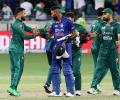
Saikia stressed that the Indian cricket board will continue to adhere to the policy formalised by the government.

Afghan Foreign Minister Amir Khan Muttaqi announced that Kabul will send diplomats to India as part of efforts to improve bilateral relations. He assured New Delhi that Afghan soil will not be used for activities detrimental to India's interests.

'We want our girls to bring their A game on the day. We want them to take it just as a game because the World Cup is a long campaign.'

'Operation Sindoor is still ongoing. The Prime Minister himself said that blood and water cannot flow together, that talks and terrorism cannot go together. So how can we have a cricket match with a country that indulges in terrorism?'

An Indian commerce ministry team has reached Washington for another round of talks from Monday on the proposed bilateral trade agreement (BTA), an official said. Chief negotiator of India and special secretary in the Department of Commerce, Rajesh Agrawal, will join the team on Wednesday.
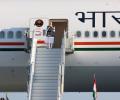
The Kananaskis gathering on June 16-17 is the Prime Minister's 6th consecutive participation in the G7 Summit.

'Given the lag in transmission, further softening of lending rates may happen in the coming months.'

The two sides also inked four pacts to expand cooperation in areas of railways and energy.

Several opposition parties on Saturday slammed the BJP-led central government, calling it the India-Pakistan Asia Cup match an insult to the victims of the Pahalgam terror attack.
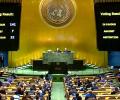
India abstained from a UN General Assembly vote on a resolution regarding Afghanistan, citing the need for a balanced approach that combines incentives and disincentives, and calling for new initiatives to address the humanitarian crisis.
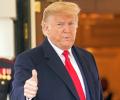
India and the US have concluded the fifth round of talks for the proposed bilateral trade agreement (BTA) in Washington. Both sides are looking at finalising an interim trade deal before August 1. Issues related to agriculture and automobiles figured during the negotiations.

Officials said the government-to-government engagement between the two countries on all other issues remains normal, but conceded rough spots over trade that need ironing out.
Chinese envoy Xu Feihong stated that China opposes the US imposing tariffs on India, amidst a thaw in Sino-India relations and concerns over global trade disruptions.
Strategic affairs experts express concern over US President Donald Trump's tariffs on India, his 'bullying tactics,' and increasing attempts to hyphenate New Delhi with Islamabad, signaling a potential shift in the bilateral relationship.

United States President Donald Trump on Wednesday said Prime Minister Narendra Modi had assured him that India would stop purchasing oil from Russia, describing it as "a big step" in efforts to increase global pressure on Moscow.
In a post on X on Saturday, Zelenskyy revealed that he and Trump had held a "long and substantive" call, beginning with one-on-one talks and later including European leaders in a broader discussion, where Trump briefed him on his recent meeting with Putin.
India and the US desire to give preferential market access to each other's businesses and teams of both the countries are working together on the proposed bilateral trade agreement, Commerce Minister Piyush Goyal has said. In February, US President Donald J Trump and Prime Minister of India Narendra Modi announced plans to negotiate the first tranche or phase of a mutually beneficial, multi-sector Bilateral Trade Agreement (BTA) by fall (September-October) of 2025.

External Affairs Minister S Jaishankar has raised India's long-standing concerns about pro-Khalistan extremism in the United Kingdom during his meetings with the country's leaders, stressing that they should be on guard against the misuse of freedom of expression and speech.
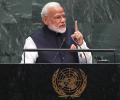
External Affairs Minister S Jaishankar will address the session on September 27
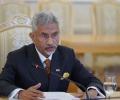
The relations between New Delhi and Washington are on a downturn after Trump doubled tariffs on Indian goods to a whopping 50 per cent, including 25 per cent additional duties for India's purchase of Russian crude oil.

Prime Minister Narendra Modi conveyed to Ukrainian President Volodymyr Zelenskyy that India remains committed to making every possible contribution for an early and peaceful solution to the conflict. Zelenskyy sought India's support in limiting Russian energy exports.

Pakistan's Air Force Chief Zaheer Ahmed Baber Sidhu visited the US to enhance bilateral defence cooperation, following a similar visit by the Army Chief. The visit included meetings with US military and political leaders to discuss regional security, counter-terrorism efforts, and future cooperation.
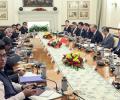
Chinese Foreign Minister Wang Yi's visit to India focuses on border talks with NSA Ajit Doval, amidst efforts to rebuild relations after the Galwan Valley clashes and rising India-US tensions.

A deep dive into Trump's new policy and what it means for Indian professionals and companies.
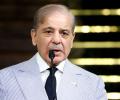
United States President Donald Trump is set to engage in high-stakes bilateral meetings on Thursday, including a closed-door session with Pakistan's Prime Minister Shehbaz Sharif in the Oval Office, according to Trump's public schedule released by the White House.

Restricting air access to foreign carriers by not granting them more bilateral rights is akin to shooting yourself in the foot, as air transport is a wealth multiplier for India's economy, Emirates President Tim Clark said during a press conference held on the sidelines of the annual general meeting of the International Air Transport Association.

One key development is the direct cargo connection between Chennai and Vladivostok, a crucial Russian port on the Northern Sea Route.

Modi held a "productive meeting" with his Ethiopian counterpart Abiy Ahmed Ali on a day when BRICS (Brazil, Russia, India, China and South Africa) leaders officially endorsed Ethiopia's entry into the bloc.

'I have no doubt the players share the compassion and feeling of the vast majority of the Indian public.'

For too long has Pakistan gotten away with running with the terrorists and hunting with the forces. This duplicity needs to end, asserts Saisuresh Sivaswamy.

Supporting Trump's proposal for a trilateral meeting between Ukraine, the US, and Russia, Zelenskyy said, "Key issues can be discussed at the level of leaders, and a trilateral format is suitable for this."

Defence Minister Rajnath Singh has conveyed to his Chinese counterpart Admiral Dong Jun that India and China should maintain the positive momentum in the bilateral ties and avoid adding new complexities.

In multilateral contests, it would go by the Olympic Charter, which prohibits any discrimination based on political issues, which is why the government has stated that it would not stop Pakistan from coming to India for international events.

Prime Minister Narendra Modi condemned the violation of Qatar's sovereignty following Israeli air strikes on Doha, targeting Hamas leaders. He conveyed India's deep concern to the Emir of Qatar and reiterated support for peace and stability in the region.
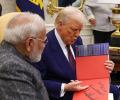
'The current strain in the relationship is serious and likely to be long lasting.' 'Even if Trump suddenly changes his attitude toward India -- which he is entirely capable of doing -- it is unlikely that New Delhi will be able to pick up the pieces and respond as if nothing has happened.'
In response to a question on President Donald Trump offering to "mediate" on the issue of Kashmir, Bruce said, "Well, I - obviously, I can't speak to what's on the mind or the plans of the President. What I do know is that I think we all recognise that President Trump in each step that he takes, it's made to solve generational differences between countries, generational war."

China appears determined to upgrade Pakistan's military capabilities, sufficient to ensure local parity with India, alerts former foreign secretary Ambassador Shyam Saran.
China firmly opposes the Trump administration's 50 percent tariffs on India as it is "unfair and unreasonable" and New Delhi and Beijing should scale up economic ties to jointly counter the challenge, Chinese ambassador Xu Feihong said on Monday.

The delayed timing of J&K Lieutenant Governor Manoj Sinha's admission has more to do with deflecting the thrust of the Opposition attack on the prime minister and Union home minister during the monsoon session of Parliament, points out Mohammad Sayeed Malik, the distinguished commentator on Kashmir affairs.

India and Pakistan agreed on May 10 for a cessation of firing and military activity as a result of 'direct contact' between the director generals of military operations (DGMOs) of both nations, which was 'initiated by the Pakistani side', the Centre informed Parliament on Friday.
